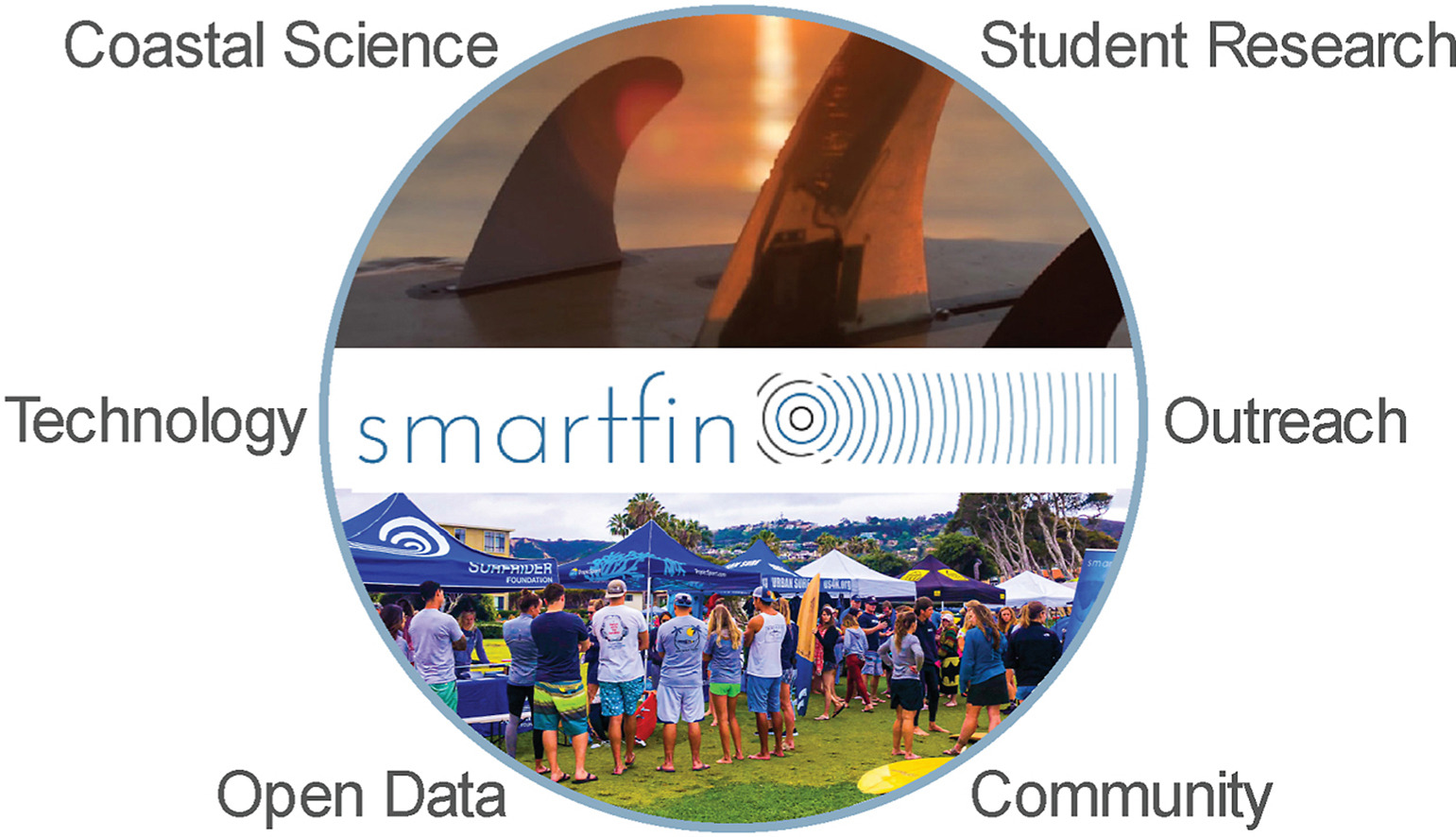
The Smartfin project was highlighted in a ThisWeek@UCSD article. The Smartfin holds a microcontroller, temperature sensor, inertial measurement unit, and wireless radio — all embedded into a surfboard fin. This allows surfers to opportunistically gather oceanographic data in the near-shore environment, which is otherwise challenging for more traditionally sensors on buoys and moorings. Engineers for Exploration students are working this summer as part of the NSF-funded REU Site to solidify the data collection process, and develop in-house ability to manufacture Smartfins in a low-cost and open-source manner.
Francesco Restuccia was invited to give a talk at the June 2022 edition of hardware.io — a conference dedicated towards showcasing novel hardware attacks and training the security community to defend against those attacks. Francesco’s talk details how the popular on-chip communication protocol is prone to attacks against the security and safety of on-chip resources. The attacks take advantage of inadequacies in the protocol, which was developed for high-speed communications, and not necessarily designed with safety and security in mind. For more details, check out his talk in its entiretly.
One of the biggest challenges in hardware security verification is developing formal properties that can subsequently be verified by automated tools. This is a difficult and time-consuming task typically assigned to security verification engineers that must manually sort through hundreds of thousands of lines of a hardware description.
Congratulations to Olivia Weng for being awarded a National Science Foundation Graduate Research Fellowship. The NSF GRF is one of the most prestigious graduate fellowships in the US. The fellowship will fund Liv for the remainder of her PhD allowing her to continue her research on the co-design of efficient, fault-tolerant computer architectures for applications in high-energy physics. One example is the Large Hadron Collider, where physicists need hardware that will process millions of particle collisions per second. Her research will allow their hardware, and the machine learning software that runs on it, to meet these intense computing demands while handing faults that are inherent in such sensors.
Smartfin is an oceanographic sensor–equipped surfboard fin and citizen science program aimed to provide an increase of coastal ocean observations. Smartfins are used by surfers and paddlers in surf zone and nearshore regions to provide valuable oceanographic data in these challenging to sample ecosystems. Smartfin measures temperature, motion, and wet/dry sensing, GPS location, and cellular data transmission capabilities for the near-real-time monitoring of coastal physics and environmental parameters.
Over 300 Smartfins have been distributed around the world and have been in use for up to five years. The technology has been proven to be a useful scientific research tool in the coastal ocean—especially for observing spatiotemporal variability, validating remotely sensed data, and characterizing surface water depth profiles when combined with other tools—and the project has yielded promising results in terms of formal and informal education and community engagement in coastal health issues with broad international reach.
Our recent research article in the Continental Shelf Research journal describes the technology, the citizen science project design, and the results in terms of natural and social science analyses. We also discuss progress toward our outreach, education, and scientific goals. Congrats to Phil Bresnahan and all the authors!
Design space exploration aims to quickly determine the design parameters that yield the best results. In software, the designer must set algorithmic and performance parameters, e.g., thresholds, bounds, and other input parameters that provide the best output in terms of accuracy and runtime. In hardware design, the designer must determine parameters related to pipelining, memory architecture, and data types to give the best tradeoff between resource usage and performance. In both cases, one wants to quickly understand the relationship between the input and outputs and find the Pareto set of designs.
Sherlock is a DSE framework that can handle multiple conflicting optimization objectives and aggressively focuses on finding Pareto optimal solutions. Sherlock integrates a model selection process to choose the regression model that helps reach the optimal solution faster. Sherlock designs a strategy based around the Multi-Armed Bandit (MAB) problem, opting to balance exploration and exploitation based on the learned and expected results. Sherlock can decrease the importance of models that do not provide correct estimates, reaching the optimal design faster. Sherlock is capable of tailoring its choice of regression models to the problem at hand, leading to a model that best reflects the application design space
“Sherlock: A Multi-Objective Design Space Exploration Framework” was recently published in the ACM Transactions on Design Automation of Electronic Systems (TODAES). Congrats to the authors Quentin Gautier, Alric Althoff, Chris Crutchfield, and Ryan Kastner. The Sherlock algorithm was also released as open-source. We plan to use it in the future to tune machine learning models for optimized hardware implementations and tune algorithmic parameters for aerial tracking project. We hope that others will find is similarly useful!
Our large-scale 3D modeling work was featured on the National Geographic Docuseries “Ancient China from Above“. We developed 3D models using drones, multispectral cameras, lidar, and other cutting edge technology, which provided archaeologist Alan Maca new insights to better understand ancient Chinese civilizations.
As part of the production, Ryan and Eric Lo traveled to some of the most remote parts of China including Xanadu (Kublai Khan’s summer palace in Inner Mongolia), the Han Great Wall in the Gobi Desert, and Shimao — a new archaeological site known as China’s Pompeii located on the Loess plateau.
The three part series aired on the National Geographic Channel and is available on most video streaming platforms. The full “Secrets of the Great Wall” episode is available on YouTube. We appear around the 26 minute mark.
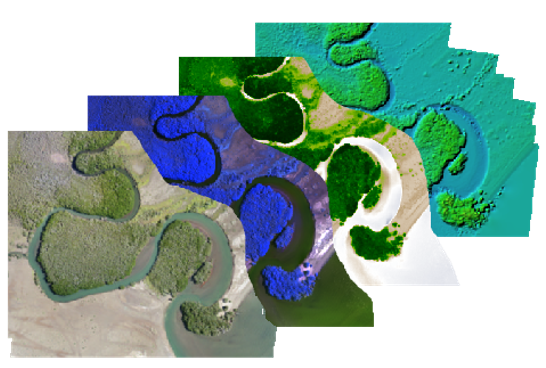
Did you know that mangroves sequester more carbon than rainforests? In addition to being one of the best carbon scrubbers in the world, they also protect coastlines from erosion and hurricanes and provide an amazing nursery for aquatic life. Yet, these important ecosystems are in-decline worldwide, hurt by industrialization, rising sea levels, and other climatic events.
As part of the activities around World Mangrove Day, Ryan moderated an online panel “The Science Behind Remote Sensing” related to using technology to monitor and rehabilitate mangroves. The panel featured researchers from NASA, Microsoft, UCSD, and the Nature Conservancy are using drones, satellites, multispectral imaging, machine learning, and a bunch of other technologies to understand and rehabilitate mangroves around the world. Our collaborator Astrid Hsu presented some of the technologies that we are working on as part of Engineers for Exploration program. And there was a lot of interesting discussion on how to use technology to monitor, understand, and rehabilitate these important ecosystems.
Digitally documenting archaeological sites provides high-resolution 3D models that are more accurate than traditional analog (manual) recordings. Capturing the 3D data comes at great financial cost (if using a lidar-based system) or be time-consuming during data collection and post-processing (when using photogrammetry). This has limited the use of these techniques in the field.
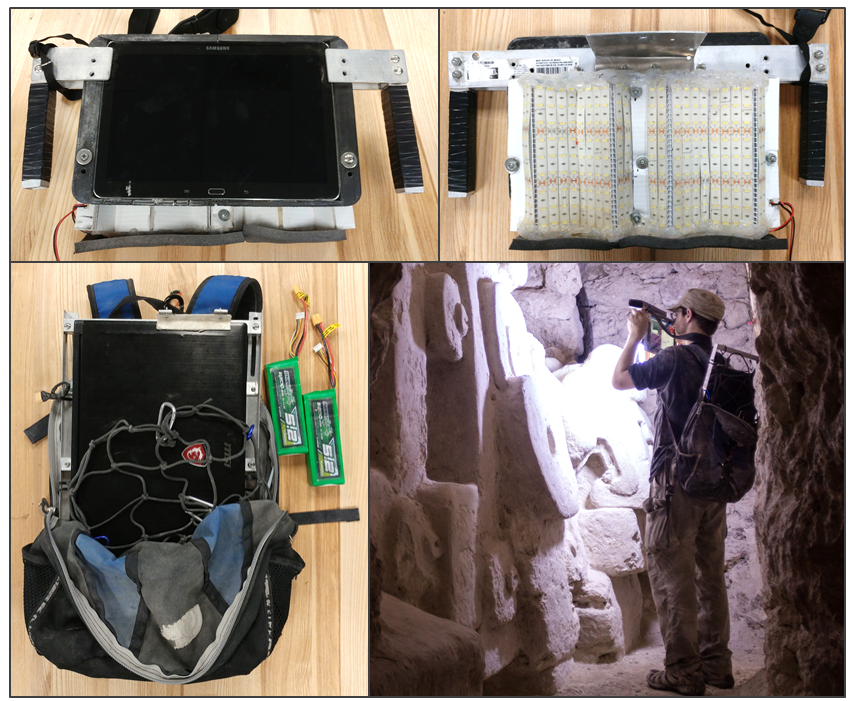
Depth sensors like the Microsoft Kinect and Intel RealSense provide relative low-cost way of capturing depth data. Open-source 3D mapping software provides fast and accurate algorithms to turn this depth data into 3D models. Our research combines depth sensors and 3D mapping algorithms to develop a low-cost 3D scanning system. We analyzed multiple sensors and software packages to develop a prototype system to create large scale 3D model of tunneling-based archaeological site. We used this system to document Maya archaeological site El Zotz in the Peten region of Guatemala. Our findings were recently published in the paper “Low-cost 3D scanning systems for cultural heritage documentation” in the Journal of Cultural Heritage Management and Sustainable Development.
This research is the result of a many year (and on-going) effort between Engineers for Exploration and archaeologists at El Zotz. Congrats to all those involved in this impressive project.
Advanced wireless communication techniques, like those found in 5G and beyond, require low latency while operating on high throughput streams of radio frequency (RF) data. Automatic Modulation Classification is one important method to understand how other radios are using the wireless channel. This information can be used in applications such as cognitive radios to better utilize the wireless channel and transmit information at faster rates.
Our recent work shows how to perform modulation classification in real-time by exploiting the RF capabilities offered by Xilinx RFSoC platforms. This work, lead by the University of Sydney Computer Engineering Lab, developed a non-uniform and layer-wise quantization technique to shrink the large memory footprint of neural networks to fit on the FPGA fabric. This technique preserves the classification accuracy in a real-time implementation. This work was published at the Reconfigurable Architectures Workshop (RAW) and an open source implementation on Xilinx RFSoC ZCU111 development board is available at in the github repo.