 Our research to develop a low energy system for canonical Huffman encoding was accepted to the IEEE International Conference on Application-specific Systems, Architectures, and Processors (ASAP). The paper was the result of work done last summer during Janarbek‘s internship at Microsoft Research. It is a collaborative work with Joo-Young Kim at MSR.
Author Archives: Ryan
Best Poster Award at Research Expo
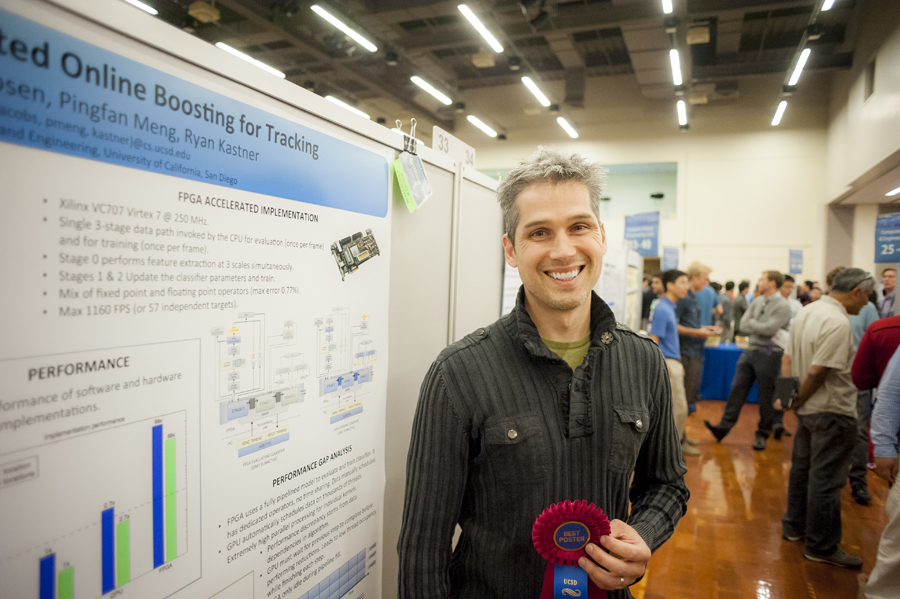 Matt Jacobsen and Pingfan Meng’s research on object tracking won the Best Poster Award for Computer Science and Engineering at the Jacobs School Research Expo on Thursday April 17. From the Jacobs School Press release: They developed a computer vision tracking system that is faster and more accurate than the current state of the art. They did so by devising an algorithm that divides the processing between software running on a CPU and custom hardware implemented using a field-programmable gate array. This system can track a single target at 1160 frames per second or 57 independent targets at 30 frames per second. That’s 68 times faster than an approach that uses software only. This considerable increase in computing power improves the accuracy of the tracking algorithm by tracking multiple targets on the object under consideration. For example, instead of tracking a hand using a single target, the system will track six objects – each of the fingers and the palm – making it significantly more accurate.
Expeditions Highlighted in UT San Diego Newspaper Article
 Our upcoming expeditions to Lake Tahoe and Guatemala where highlighted in the UT San Diego newspaper article discussing where San Diego scientists are doing field research over the summer. Ryan and Curt Schurgers will once again venture into the Guatemalan jungle to the Maya archaeological site El Zotz to support USC archaeologist Tom Garrison in the excavation of a temple. We will be using lidar to create a 3D time lapse of the excavation. Ryan and Perry will be imaging a sunken barge in Emerald Bay in Lake Tahoe in the middle of June.
Two New NSF Graduate Research Fellows
 Perry Naughton and Alric Althoff were award National Science Foundation Graduate Research Fellowships. Perry, a second year PhD student, is involved in engineering innovation that spans robotics, signal processing, and computer vision. He is currently a CISA3 NSF IGERT-TEECH fellow. Alric, a first year PhD student, studies algorithms and hardware for compressive sensing and tensor analysis. His research aims to both decrease cost and increase performance of sensors relevant to industry and science. Alric is currently funded by the San Diego Fellowship. They join the growing list of Kastner Group members receiving NSF Graduate Research Fellows; this includes current group members Jason Oberg and Dustin Richmond, and previous group members Bridget Benson and Jennifer Trezzo. See the CSE press release for more info
ERA Keynote
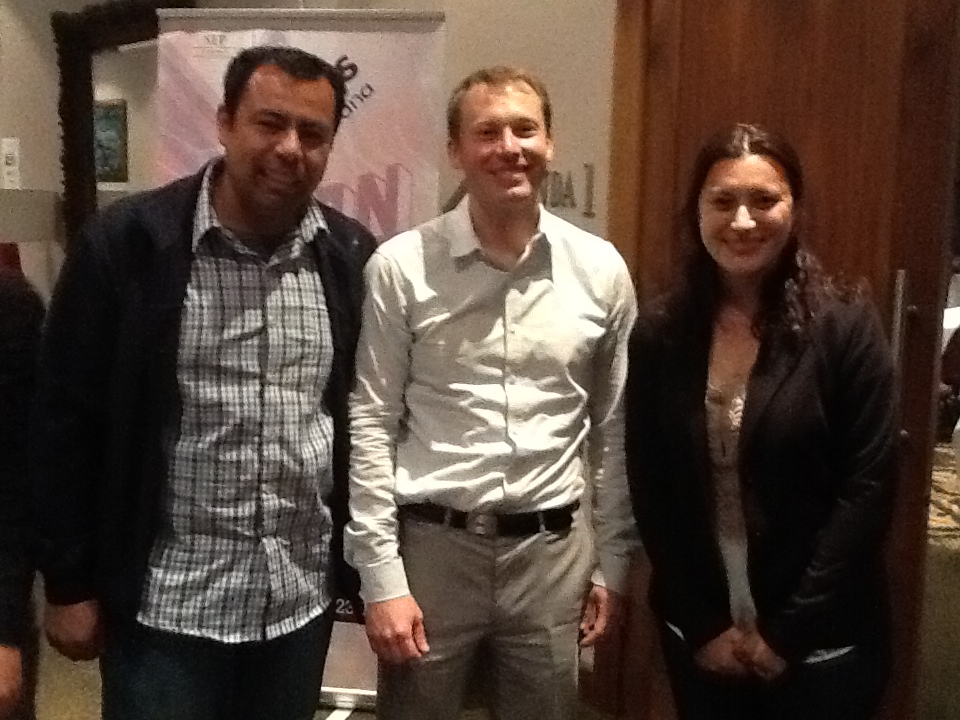 Ryan gave a keynote at the Encuentro Regional Academico (ERA) conference in Tijuana, Mexico on April 10. The presentation focused on the projects in our Engineers for Exploration program. While he was there, he saw a couple of familiar face – Kenia Picos and Ulises Orozco – who spent time as visiting students in the Kastner Group.
Innovation Trends Cyber Security Symposium
 Ryan is the moderator for the iTrends Symposium on Cyber Security held Thursday April 8 at the Qualcomm Institute. The symposium aims to education UCSD students on the opportunities in Cyber Security. The panelist include Dr. Stephen D. Russell, SPAWAR Director of Science & Technology/CTO, Jeff Nichols, Director of Information Technology, Sempra Energy, Paul Martini, Co-founder/CEO, iboss Network Security, and Chad Nelly, Vice President of Operations, ESET North America.
Security Technology Featured at San Diego Venture Group Event
 Tortuga Logic, a startup spun out of the Kastner Group, was one of the companies highlighted at the San Diego Venture Group’s ‘Incubators and Accelerators’ event at the Hyatt Regency. This event featured over 300 investors, entrepreneurs, and industry professionals. Tortuga Logic develops technology for creating provably secure systems.
Hardware Accelerated Object Tracking Paper Accepted to FCCM
 Our paper, which builds a hardware accelerated system for multiple target tracking, was accepted to FCCM 2014. Our system combines multi-core CPU and an FPGA; this allows it to run over 65 times faster than a highly optimized multithreaded implementation running only in software. Congrats to the authors, Matt Jacobsen, Pingfan Meng, Siddarth Sampangi, and Ryan Kastner.
Brina Lee discusses life as first Instagram female engineer
 Brina, a Kastner group MS Alumna, was the first female engineer at Instagram. In a recent interview in Elle magazine, she discusses her journey into studying computer science and the challenges of being a minority in a large tech company (Instagram is now a part of Facebook). Brina previously had an op-ed in the Huffington Post providing more specifics on how she became a software engineer.
Medical Device Security Workshop
 In his panel talk at the HIMSS workshop “Medical Device Security Risks and Challenges: A Multidisciplinary Response”, Ryan urged the medical device community must start considering hardware in their quest of building reliable and security medical devices. He also called for enhanced collaboration between a bevy of different stakeholders who develop, use, and regulate these devices. A discussion on this (and more) can be found in a interview that he gave to the Healthcare Info Security Group.